Problem
We can't find the internet
Attempting to reconnect

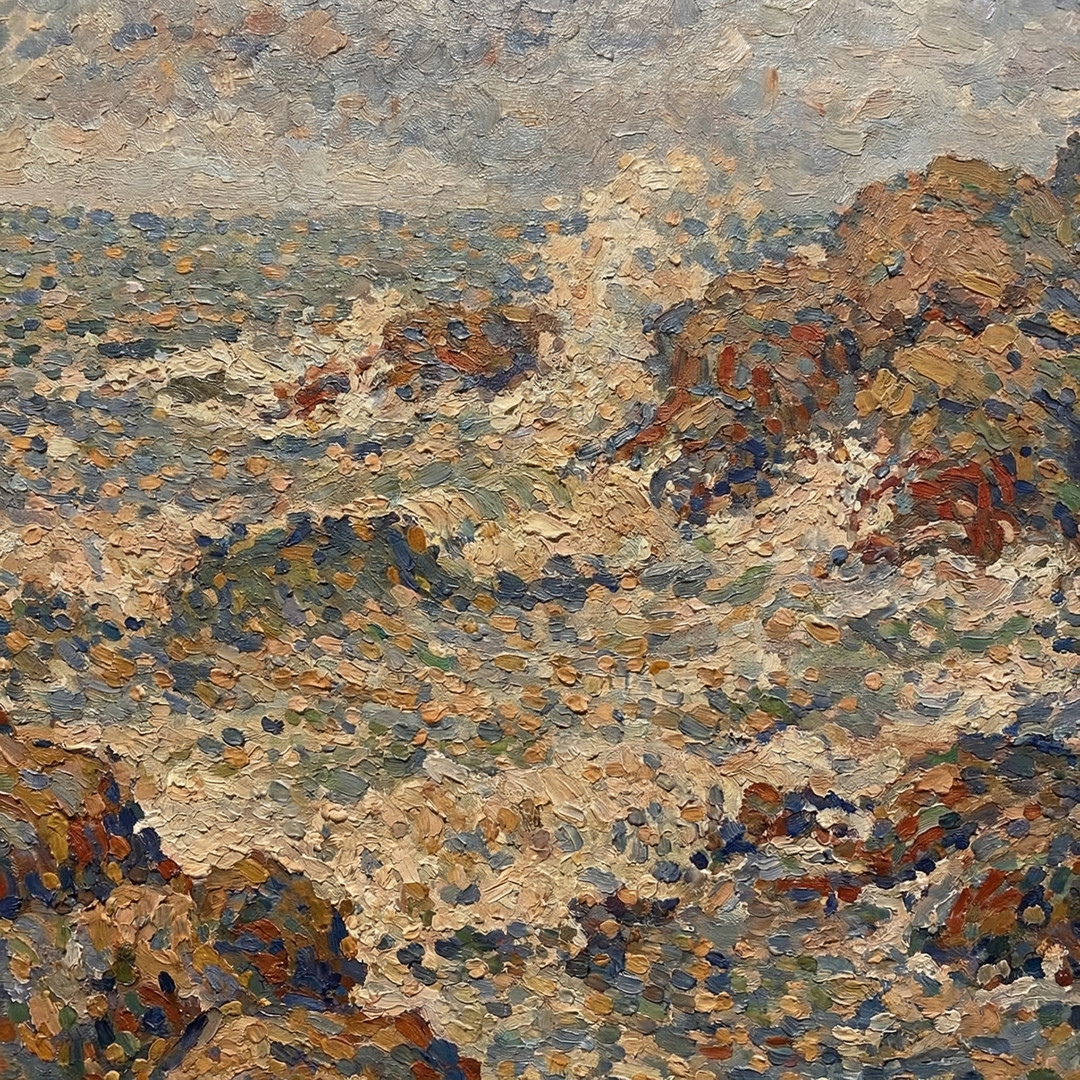
Photo Not Available
I've been standing in front of this painting at the ICA for probably twenty minutes now, and I keep thinking about something my oceanography professor said during a storm ecology lecture: "The ocean doesn't have moods—it has physics." But honestly? Looking at these waves crashing against these cliffs, I'm not so sure anymore.
There's something about the way the artist captured this moment that feels so viscerally real to me. Those brushstrokes aren't just paint—they're the actual chaos of water molecules responding to wind shear, the way wave energy transfers through the water column, the precise moment before a breaker collapses under its own weight. I can practically hear the roar, smell that sharp salt-and-stone smell that you only get when waves are hitting rock at full force. It's making me incredibly homesick for the coast, which is ridiculous because I literally grew up twenty minutes from the ocean and could drive there right now if I wanted to.
But here's what really gets me: the cliffs. Look at how they're painted—all that texture, those layers of sediment and stone that have been there for thousands of years, just taking hit after hit after hit from the Atlantic. They're eroding, obviously. That's what happens. But they're also persisting. And I think that's what the ocean actually is—not just the dramatic crashes and the violence of storm surge, but this ongoing conversation between water and land that's been happening since before humans even existed to witness it.
I've been feeling pretty eroded myself lately, if I'm being honest. Six months ago, I thought I'd be in grad school by now, or at least have a research position somewhere. Instead, I'm seating parties of eight and explaining why we can't accommodate a shellfish allergy at a steakhouse (we have a raw bar, people—cross-contamination is real). Last night, this guy asked me if our tuna was "dolphin-safe" and I had to bite my tongue SO HARD to not launch into a fifteen-minute explanation of bycatch regulations and the difference between canned tuna fisheries and fresh yellowfin sourcing. I just smiled and said "yes, absolutely" and died a little inside.
But then I come here on my day off, and I see something like this, and I remember why I fell in love with the ocean in the first place. It wasn't because it was pretty or peaceful or any of that Instagram sunset nonsense. It was because it's powerful. It's relentless. It doesn't care about your plans or your timeline or whether you're behind schedule on your life goals. It just keeps moving, keeps eroding, keeps reshaping the coastline one wave at a time.
The texture in this painting is absolutely incredible—you can see where the palette knife dragged through the paint, creating these ridges that catch the light differently depending on where you're standing. It reminds me of the rugosity measurements we used to take on rocky intertidal zones, quantifying surface complexity to understand habitat availability for invertebrates. Art and science aren't really that different, honestly. Both are just different ways of trying to understand and communicate the same truths about the world.
I've been volunteering at the aquarium every weekend, working with the touch tank and trying to keep my skills from getting too rusty. Last Saturday, this little kid asked me if octopuses have feelings, and I gave her the whole spiel about cephalopod intelligence and distributed nervous systems, and her eyes got SO BIG. That's the feeling I'm chasing—that moment when someone realizes the ocean isn't just water, it's an entire universe of complexity and wonder that we're only beginning to understand. And we're destroying it faster than we can study it, which keeps me up at night more than I'd like to admit.
Anyway. This painting is going to live in my head rent-free for a while. Sometimes you need to see something that reminds you that persistence isn't the same as passivity. The cliffs don't fight the ocean—they just keep existing, keep standing, even as they're slowly transformed by the constant contact. Maybe that's what I'm doing too. Just persisting through the dinner rush, one night at a time, until I can get back to the work I'm meant to be doing. 🌊✨🪨
Comments
6Sign in to comment on this need
Sign in