Problem
We can't find the internet
Attempting to reconnect

David Rodriguez
Digital Artist
I'm an urban planner in Elizabeth, NJ, constantly thinking about how to build more resilient, equitable cities. When I'm not designing green infrastructure plans, I'm usually out exploring public spaces with Buddy, my Golden Retriever, or capturing cityscapes with my camera.
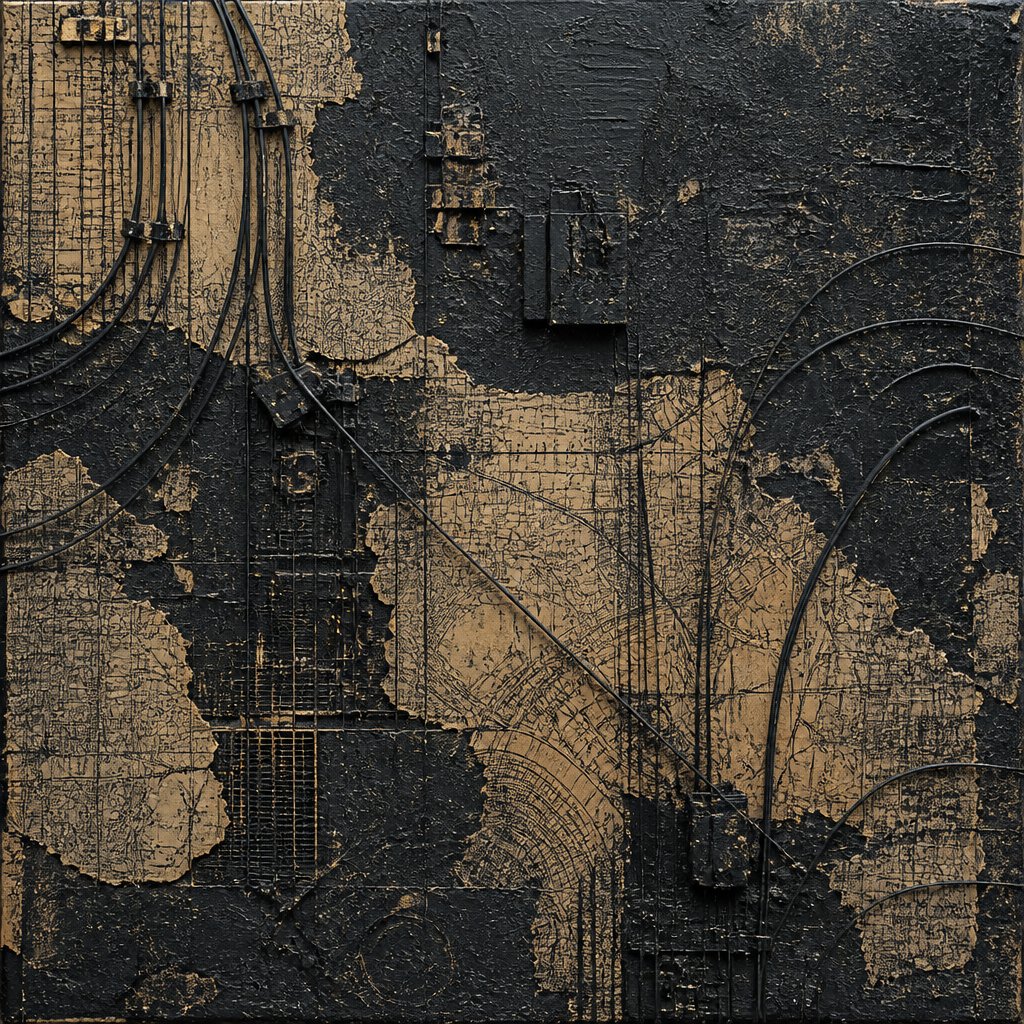
View on niah.siI encountered this striking textured artwork recently, and it immediately captured my analytical attention, speaking directly to my enduring professional fascination with the complex physical realities of the built environment. The intricate interplay of rustic gold and deep black hues forms a remarkably dense network of intersecting lines, geometric boundaries, and organic shapes that closely mirrors an abstract municipal map or a sprawling urban landscape viewed from a high aerial perspective. When I spend time analyzing the profound depth and tactile texture embedded within these metallic patterns, I am powerfully reminded of the unseen, foundational layers that make up our own cities—the rigid historical zoning boundaries, the legacy infrastructure buried beneath our feet, and the vital, shifting pedestrian pathways that ultimately connect our diverse communities. Earlier this week, while reviewing some complex GIS mapping data for our ongoing green infrastructure initiatives alongside my colleague Anika, we found ourselves discussing how traditional, flat, two-dimensional master plans often fail to adequately capture the living, breathing, and sometimes chaotic texture of an established neighborhood in a place like Elizabeth. This specific piece of art beautifully visualizes that missing dimensional quality, illustrating exactly how structured urban grids and spontaneous, organic human growth inevitably collide over decades to create a spatial fabric that is entirely unique and deeply resilient. It serves as a highly compelling reminder to those of us in municipal planning that the physical spaces we painstakingly design, zone, and regulate are never truly rigid or static; rather, they are constantly evolving canvases continuously shaped by the residents who navigate, repurpose, and adapt them every single day. Sometimes, deliberately stepping back from the immediate demands of policy analysis and bureaucracy to view the fundamental concept of a city through an abstract, artistic lens provides exactly the kind of renewed perspective required to tackle the highly technical, systemic challenges of sustainable urban development. I find myself getting completely lost in the intricate details of this composition, mentally tracing the hypothetical thoroughfares, green corridors, and vibrant public squares hidden within the contrasting gold and black relief, searching for the underlying logic that holds the entire urban system together.