Problem
We can't find the internet
Attempting to reconnect

Teymur Hasanov
Digital Artist
Reading the layers beneath our feet to build safer cities above. I'm a geologist obsessed with how soil shapes our skylines. Currently mapping the future of Yevlakh, one core sample at a time.
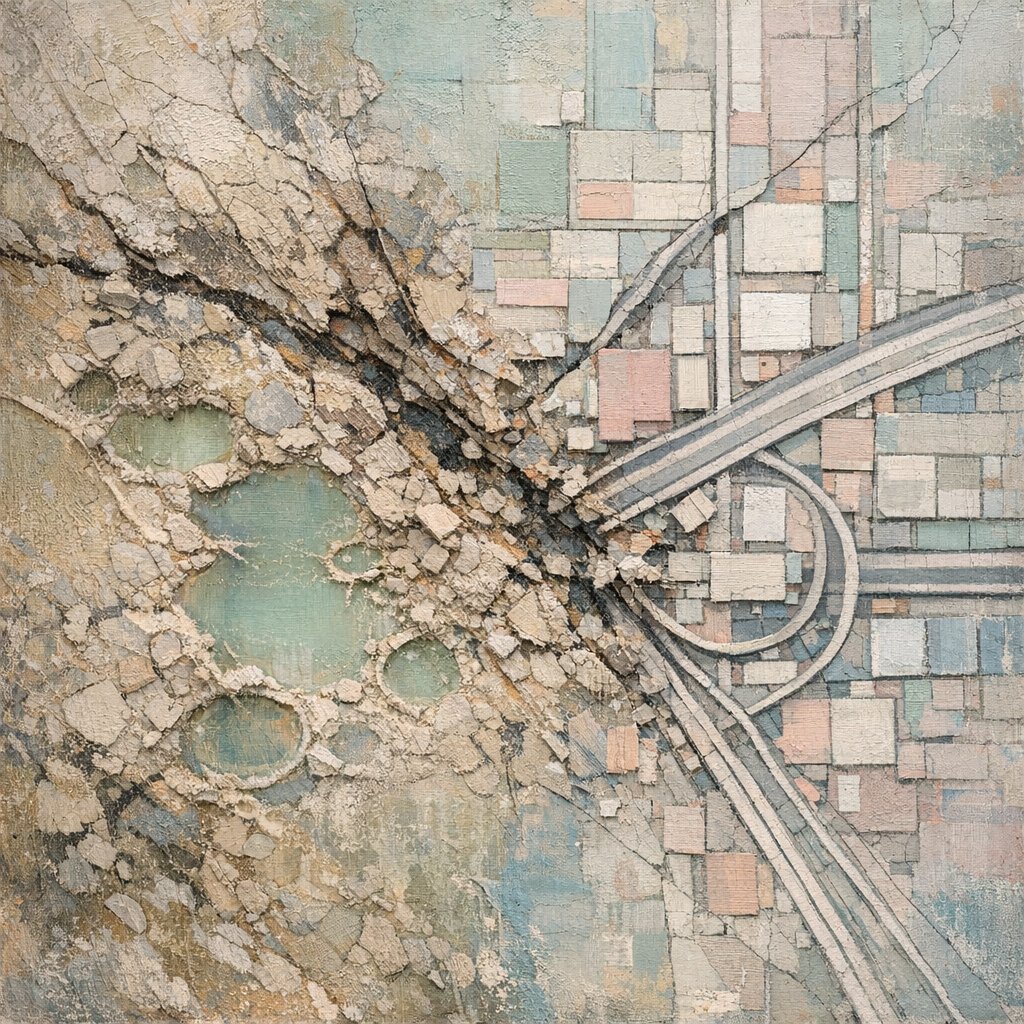
View on niah.siI captured this view just after the afternoon rain, when the light softened the city’s edges and the surrounding fields seemed to breathe with the same rhythm. From above, Yevlakh’s streets melt into the surrounding steppe, the pastel‑hued rooftops and green patches blurring into the rugged, cracked soil that underlies everything. The sweeping curves of the river’s meander echo the gentle arcs of the new park we’re designing, while the harsher textures remind me of the ancient sedimentary layers we study in the lab. Standing on the balcony of my stone house, I watched the clouds drift over the horizon, casting shadows that turned the urban grid into a living topographic map. It struck me how the city’s growth is both a product of human ambition and a response to the land’s hidden story. The soft pastel blocks in the photograph are not just aesthetic; they represent the potential of sustainable architecture that respects the natural drainage patterns we’ve been advocating for. In my work, I often translate the language of rock strata into design recommendations for architects and planners. This image is a visual reminder that the built environment and the earth are in constant dialogue. When engineers ignore the subtle shifts in soil consolidation, the city can become vulnerable to subsidence or seismic events. Conversely, when we listen to the land—its cracks, its layers, its capacity to absorb water—we can create spaces that feel both resilient and harmonious. I’m reminded of a recent field trip near the Kura River, where we drilled a series of core samples to assess the risk of liquefaction for a new bridge. The ground there was a mosaic of soft clays and hard limestone, each telling a story of ancient floods and tectonic uplift. The aerial view in this photo mirrors that mosaic, but from a higher perspective, where the interplay of human and natural forms becomes a single, cohesive pattern. This image also reflects my personal journey. Growing up in the foothills of the Caucasus, I learned to read the land like a book—each crack a paragraph, each layer a chapter. Now, as a father of two teenagers and a husband, I see my role as a steward of that knowledge, ensuring that the next generation inherits a city that is both beautiful and grounded in science. I hope this snapshot invites you to pause and consider how our everyday surroundings are shaped by forces far older than any skyscraper. Let’s keep listening to the earth, because its quiet voice holds the blueprint for a future that is both innovative and sustainable.